
Why Salesforce’s Shift to Data Cloud Matters for Your Business
Salesforce Data Cloud is redefining CRM, segmentation, and AI. Learn how to prepare your B2B team for this shift and build a future-proof Salesforce stack.
The Big Picture
Salesforce is changing in a major way. It’s moving from a patchwork of cloud-specific data tools toward a single, centralized platform powered by Data Cloud (previously known as Genie). This isn’t just a product update — it’s a foundational shift in how Salesforce works, especially for businesses that use tools like Marketing Cloud, Sales Cloud, Tableau, and more.
This move is designed to unify your customer data, make real-time personalization possible, and power a new generation of AI-driven tools like Einstein Copilot. If your business is running Salesforce — or planning to — this shift should directly influence how you structure projects, build teams, and deliver customer experiences.
What’s Changing Behind the Scenes
From Silos to One Unified Data Engine
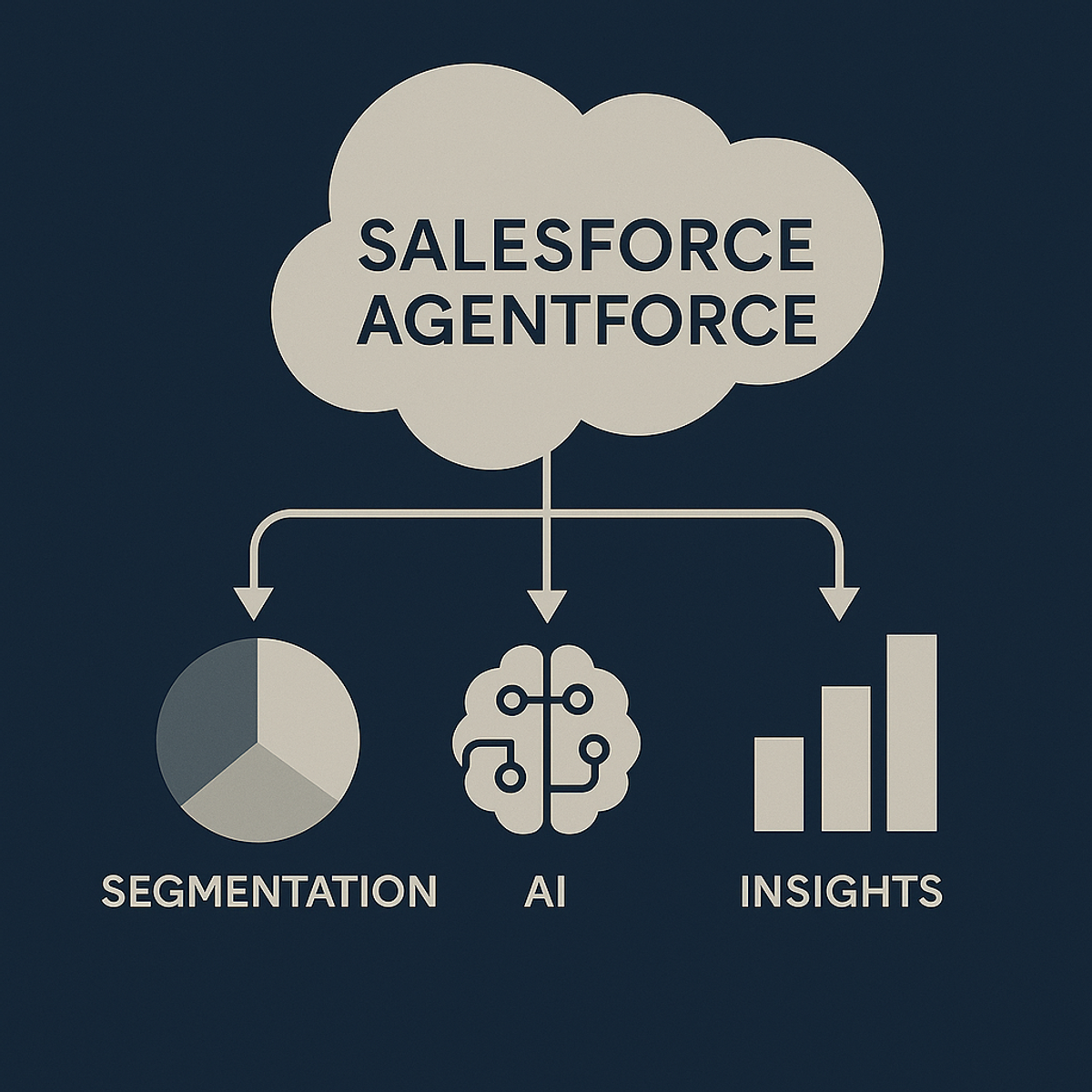
Salesforce used to operate with cloud-specific data models: Sales Cloud had its records, Marketing Cloud had its own audience tables, and tools like Datorama were disconnected from everything else. Now, Salesforce is centralizing all that under Data Cloud:
- Unified Customer 360 profiles
- Real-time segmentation and activation
- Built-in AI context and orchestration
- Federated and streaming data ingestion
- Prompt-based automation through Einstein Copilot and Prompt Studio
New Tools Built on Top of This Core:
- Data Cloud (CDP + Identity Graph)
- Calculated Insights, Segmentation, Activation
- Copilot Studio and Prompt Studio
- Tableau dashboards powered by real-time Data Cloud data
- AI copilots in Slack, Sales, Service, and Tableau
Bottom line: If your teams aren’t connected to Data Cloud, you’re going to miss out on almost every major innovation Salesforce is releasing from this point forward.
What This Means for Teams Like Yours
You’re likely using some combination of Tableau, Sales Cloud, Marketing Cloud, Personalization, and Marketing Intelligence. That puts you in the center of Salesforce’s transition.
Here’s a quick guide to how this will affect your operations and where you’ll need to shift focus:
Beyond tools and tactics, there’s also a cultural shift at play. Consulting and dev teams need to shift from configuring objects to designing real-time customer experiences driven by unified data.
What This Means for Our B2B Customers
As a B2B company, you're likely using Salesforce to manage lead flow, engage key accounts, run campaigns, and report on performance. With Salesforce’s move to Data Cloud, here’s what you should expect — and where to focus.
If You’re Already on Salesforce
- Marketing Cloud users: It’s time to start transitioning to Data Cloud Segments. This is where all future segmentation, activation, and personalization will happen. Legacy audiences will be left behind.
- Sales and Service users: The AI capabilities coming via Einstein Copilot will begin pulling context from Data Cloud. The better your data is modeled and unified, the smarter these tools will become.
- Tableau or Marketing Intelligence users: You’ll want to align your dashboards with Data Cloud inputs for accurate, real-time insight.Recommendations:
- Begin building a plan to integrate Data Cloud into your marketing and sales workflows.
- Start consolidating customer data into unified profiles — this will power both personalization and smarter reporting.
- Prepare for more intelligent AI experiences by investing in clean data and real-time event streaming.
If You’re Just Getting Started with Salesforce
- Structure your initial implementation around Data Cloud-first architecture.
- Design segments and audiences using Calculated Insights and real-time triggers.
- Make identity resolution and data unification a core part of your onboarding process.
- Think long-term: the more you build with Data Cloud now, the more future-proof and AI-ready your platform will be.
We’re helping clients take the next step with Salesforce by building around the Data Cloud foundation from the beginning — whether that’s transitioning existing workflows or designing new architecture for scale and AI enablement.
Where to Focus Development Going Forward
Here’s what you should prioritize internally:
- Train every team member in Data Cloud fundamentals: data modeling, transforms, identity resolution, segments
- Update your implementation playbooks with a Data Cloud-first lens
- Transition reporting flows to go from Data Cloud → Tableau
- Start developing new service packages like:
- Segment-as-a-Service
- AI Readiness Workshops (Copilot, Prompt Studio)
- Real-time personalization enablement
What’s Still Stable (For Now)
CRM tools like Sales Cloud and Service Cloud still work without Data Cloud — but that won’t last forever.
They currently run on object-based models (Leads, Contacts, etc.), but AI tools like Einstein Copilot are already tapping into Data Cloud where available.
Our Advice: Even if your CRM use case is simple, start layering in Data Cloud context now — think web behavior, engagement summaries, calculated scores — so your teams are ready when AI becomes core to the experience.
Wrapping Up: Data Cloud Isn’t a Feature — It’s the Future
Salesforce isn’t just a CRM anymore — it’s evolving into a real-time data and AI activation platform, with CRM as one of many layers.
That makes Data Cloud the foundation of everything going forward. If your Salesforce strategy doesn’t start with Data Cloud, it’s already behind.
At True Co., we’re helping teams design their next-gen Salesforce architecture around this new reality — unifying data, building smarter segmentation, and preparing for AI-native workflows.
If your team is planning its next Salesforce phase, let’s talk. The earlier you adapt to Data Cloud, the more future-proof your investment becomes.
Ready to elevate your operations?
If your team is ready for the same kind of efficiency boost, let's talk about your path to a more integrated Salesforce setup.
Start the conversation